New warehouse solutions that easily scale with your business
23 Nov 2026
Linde Material Handling launches scalable systems for pallet storage and small-item order picking
Whether faced with an imminent shortage of warehouse space, outdated warehouse technology, or the need to use existing warehouse space as efficiently as possible, logistics managers today are seeking to invest in solutions that will provide them with the greatest possible flexibility for the future. Linde Material Handling (MH) is now launching two systems that offer just that: intelligent solutions for pallet storage and small-item order picking. The Linde S-MATIC cube and Linde S-MATIC bin are designed to provide optimal space utilization and a high level of flexibility, allowing storage capacity to be adapted to changing market demands.
What trend might cause demand for a particular gadget to skyrocket? What crisis could suddenly turn a slow-moving item into a bestseller? Even the most sophisticated forecasting methods cannot predict with certainty how sales of a specific product will evolve. One thing is certain: Warehouse managers face a wide range of day-to-day operational challenges. For some, tracking down replacement parts for aging automated storage and retrieval systems (ASRS) has become a continuous task. Others face straightforward space constraints. E-commerce providers and logistics service providers, on the other hand, are grappling with a particularly dynamic environment. Their product ranges are highly fragmented, and goods flows and order volumes are much more volatile. Logistics professionals at automotive suppliers, retailers, and logistics service providers share a common desire to make smart investment decisions. “With the Linde S-MATIC cube and the Linde S-MATIC bin, we’re expanding our portfolio to meet the diverse range of customer requirements and warehouse applications,” explains Roger Campbell, Senior Product Manager Integrated Offering at Linde MH.
Easily scalable: Thinking about tomorrow’s market today
The Linde S-MATIC cube is a shuttle storage system designed to transport pallets weighing up to 1,500 kilograms. It is based on a custom-built racking structure. Four-way pallet shuttles move the pallets within a single racking level, while two-way shuttles handle vertical transport between levels. “The shuttles require only as much space as a single pallet, which is a significant advantage over conventional elevators. Another benefit is the system’s high storage density,” emphasizes Roger Campbell. If a company wants to increase capacity later on as its business grows, the system can be expanded as needed. “Throughput can be increased by adding additional shuttles, regardless of storage capacity,” says the senior product manager. Furthermore, additional storage channels can be installed to increase the number of storage locations.
Optimal use of space in existing warehouses
Not all companies are able or willing to build new logistics facilities. Instead, they may choose to repurpose existing buildings. The Linde S-MATIC cube can be easily integrated into such brownfield sites. “All that’s needed is a standard concrete floor,” Campbell emphasizes. Additionally, the Linde S-MATIC cube does not require a load-bearing building envelope because it is statically supported by its own racking structure. Since the shuttle solution is designed to reach nearly the full ceiling height, existing space can be used to its full potential. The Linde S-MATIC cube can also be installed in buildings with low ceilings. “A ceiling height of eight meters is sufficient for installing a cube system. However, up to ten levels can be stacked vertically, and systems reaching heights of 40 meters can be designed on a project-by-project basis,” says the senior product manager. Thanks to its optimal use of space, the shuttle solution is ideal for deep-freeze warehouses. The high storage density results in less air volume per square meter of storage space, reducing cooling requirements and operating costs.
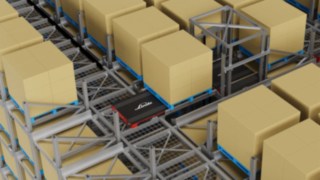
The Linde S-MATIC cube is a pallet shuttle system that maximizes space utilization. It can easily be adapted and scaled and is suitable for brownfield sites and deep-freeze warehouses.
The Linde S-MATIC cube is a pallet shuttle system that maximizes space utilization. It can easily be adapted and scaled and is suitable for brownfield sites and deep-freeze warehouses.
High throughput and long service life
Another advantage over conventional storage systems with ASRS is the system’s redundant shuttle design, which ensures that the entire system does not come to a standstill during maintenance or shuttle replacement. This also has a positive impact on the total cost of ownership. “Thanks to its precision-engineered steel construction, the rack is designed for decades of operation,” explains Campbell. “Compared to automated storage and retrieval systems, the shuttles are cost-effective and can be easily replaced when worn out.”
AI identifies the ideal storage location
A smart slotting strategy is key to the Linde S-MATIC cube's high throughput. To this end, Linde MH has developed AI-optimized pallet distribution within the “Linde Warehouse Manager” software. The AI-based system independently identifies the optimal storage location in the racking system from a vast number of possibilities. This optimizes overall pallet occupancy and prevents bottlenecks. The same applies to the retrieval of pallets. “Here, too, the algorithm allows the shuttles to operate with maximum efficiency,” says Campbell. Additionally, the shuttle system can be seamlessly integrated with the customer’s existing ERP and WMS systems via interfaces. “This enables transparent, end-to-end data flow and communication with the material flow processes connected to the shuttle system, whether they involve AGVs or manual industrial trucks.”
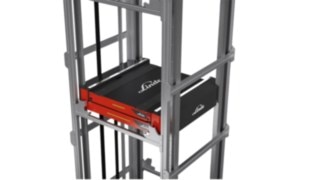
The new pallet shuttle system, Linde S-MATIC cube consists of four-way shuttles that move the pallets within a rack level and two-way shuttles that take over the elevator function to higher or lower levels.
The new pallet shuttle system, Linde S-MATIC cube consists of four-way shuttles that move the pallets within a rack level and two-way shuttles that take over the elevator function to higher or lower levels.
No loss of space: Transfer to AMR at ground level
There are three options for connecting the Linde S-MATIC cube to a picking zone or production area: transfer via roller conveyors to a stationary conveyor system, direct pickup by industrial trucks, such as laser-guided vehicles, or picking directly beneath the pallet storage system. In this configuration, the racking system is elevated above ground level, autonomous mobile robots (AMRs) retrieve the pallets and transport them to the picking zone. The pallet storage system functions as a buffer, which means the shuttles need to travel only a few levels up to restock. “All of this within the same footprint,” emphasizes the Linde MH manager.
Small-item picking: Mobile robots instead of rigid conveyor systems
In addition to the new Linde S-MATIC cube pallet storage system, Linde MH is introducing another system solution for small-item order picking. The major advantages of the Linde S-MATIC bin, in addition to its speed and compact design, include its comparatively low initial acquisition costs as well as its high flexibility and scalability. The system consists of picking robots (small-item ASRS) that travel along the racks, as well as mobile bin movers (transport robots) that transport the retrieved bins to the workstations via flexible routes. These workstations offer a high degree of flexibility, allowing for configurations tailored to specific customer needs. These include manual picking from one bin to another, exchanging full bins for empty ones, mixed picking from bins and pallets and other mixed online and offline solutions with material supply via put-wall systems, racks or conveyor belts.
The Linde S-MATIC bin stores small-item containers on racks up to twelve meters high and allows bins to be stored up to five deep. Depending on the application and process design, the solution can handle up to 400 - 600 order lines per hour per station. This increases capacity by up to 300 percent compared with manual systems. Mobile bin movers travel at speeds of up to 4.5 meters per second and can operate up to eleven hours on a single battery charge. They eliminate the need for fixed conveyor systems to transport goods to the pick-and-pack workstations. All components of this ready-to-integrate solution can be expanded incrementally and are supported by a comprehensive software ecosystem. This makes the system suitable for small and medium-sized enterprises (SMEs) and e-commerce service providers that are growing rapidly and offer a wide variety of items and variants in their product ranges. Using various gripper technologies, a wide range of load carriers – including cartons, containers and trays up to 800 mm long and 600 mm wide – can be handled.
“If throughput or picking volume increases further, additional mobile robots can be put into operation,” explains Vincent Tee, AMR/Bin Solutions & Sales Manager at Linde MH.